Game Review: "Volley and Bayonets 2, Road to Glory" The It is now several months since I play very regularly
V & B2, and this, with increasing pleasure. It was about time I make you a bit account of these parties and the lessons I have learned.
First, let's talk about the scale and system of play
The game is played at the brigade level
, which for the Napoleonic, I think we can more appropriate (this allows you to easily fix Austerlitz 6h-8h00).
The system does not lend itself to the tournament, not predefined scenario.
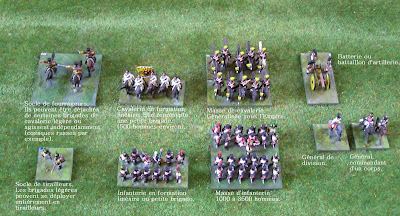
The plinth is a bit unusual. The brigades are represented by large square or rectangular chips, topped with figurines. Regardless of the number of figurines by platelets, the power the brigade is symbolized by the shape of the plate (mass or line) and by its many strong points on your sheet army. Each strength point represents approximately 500 men and 6 guns.
These large plates make the battle "highly readable". It is clear the front line and the overall movement.
The game turn represents 1:00 battle. The play is alternately turn (a player moving / fighting, then the other)
movements are large and fast. We are well into the war of movement. The cavalry, carefully kept in reserve, able to exploit any weakness in the opponent (flank exposed, disorganized troops, isolated batteries ...).
No constraint of movement, your troops can intersect, intersect, without restrictions, as these movements are voluntary. By cons, if the enemy forces you to retreat, or worse, you put to flight, the disruptive effect may extend to all the troops met with devastating effect.
The horse artillery is extremely mobile and can easily come and support your expenses by a flanking fire, which will significantly increase your chances of victory, because of the moral impact of fire on the flank.
Training: Here, do not worry whether your brigades are in square in mixed order or online. At the level of the army general as you are, it is not yours to take care of that. Just know that every scrum, a cohesion test taking into account circumstances where your troops (stationary, attacking the flank or herself making flank, infantry, cavalry opposed to ...) you will know if the brigade in question managed to get into the most appropriate training to face the enemy. A simple system, which ignores all the constraints constant formation changes (Those who have played "the Eagles", for example, know how much work it was during the big battles).
If you fail in this test of cohesion, your brigade is disorganized and in fact much less effective, a brigade in order. Its effectiveness in combat will be two times less and the enemy's cavalry could exploit this confusion to literally slash your wretched soldiers.
The simple fact of being ordered you will restore order in your squads. You can even go back into battle immediately, as long as you're close enough to the enemy.
Command: Again, the system is very simple. Your troops are ordered ... or not. To be ordered, whether it is effective in the era of your division commander, corps or army at the beginning of your movement phase. You'll then be free to move at full speed, the enemy or to "hang" the land, from "stationary". Your only constraint, ensure that at the end of your turn, your device is sufficiently focused or coherent for all your troops are ordered at the beginning of the next round. Fortunately, the general body compensate the generals of division, which can not be everywhere.
If you are not controlled: no movement toward the enemy troops desperately slow and disorder in the key!
There is no counting of points of activation of your troops to consider. You can move everything, all the time. The authors assume that the Commander in Chief (you), at least, control over the movement of the troops he leads. It's in the resolution of the random battles that take place and the situation will completely escape him.
troops and armies: Next when is your battle, armies, or not achieved their "revolution." Either they are in the pre-revolutionary where infantry fighting primarily online, or they are passed to the profound order, more powerful impact. There are therefore two types of training: "linear" or "mass". At any given time, is not a possibility. The cavalry is still in mass except for a small brigade.
Artillery can either be assembled at the division or corps, or be directly integrated brigades. In
V & B, regardless of national differences. The French soldier is worth its English counterpart or Prussian. The few changes are in the presence of specific troop (riflemen), bonus particular (eg, shock troops) or play primarily in the morale of units (between 3 and 7, again tested using a 6-sided dice).
The old guard may have up to 7 French morale, other troops will maybe 4, with the same penalties, related to lack of training). All
is quite homogeneous and there is no guarantee that you will spray the old guard your Landwher which it opposes.
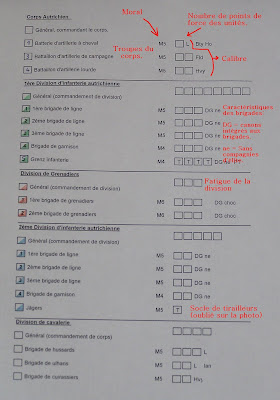
Your army is represented on a sheet of paper containing
:
the number of no loss of each of your squad, the characteristics of each
and organize your army corps by corps, division by division, as well as troops attached to the body (front guard or reserve artillery).
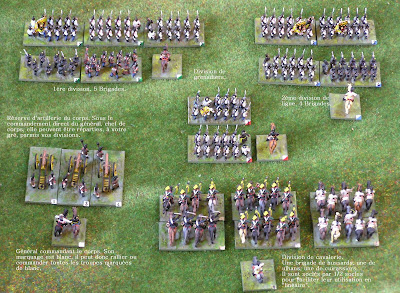
To easily locate my troops and their subordination to the heart of the game, I opted for a discreet color marking in the right rear corner of each of my bases. The same marking is found on the worksheet army. Thus, any possible confusion when registering losses.
Ci-cons, the same Austrian army (1805).
15 500 infantry 3500 cavalry, 18 guns (not counting the parts 3 and 4 pounds, each integrated brigade of infantry).
There, the battalion of Jäger (base sharpshooter)
Fighting: All the troops, worn short, the enemy guns or engaged in battle, make a jet of cohesion ( moral) and the fights are fixed in the order desired by the player phase. This
to choose the order of resolution of the fighting since the first battles can have decisive consequences on the following resolutions (disorganization, flank secure which is no longer ... etc.).
Depending on your "national organization", you will receive more or less dice to solve your shots and your mixed. The battles often pit the 1805 "fire of the allies" to the "burdens of the French. In any case, victory is never guaranteed. You start 2-4 dice per brigade, with a few extra dice depending on circumstances (stationary troops (+2 D) screen sharpshooter (+1 D), assigned to the brigade guns (+1 D) ...) or significant bonuses to hit (a dice for the shock troops, instructing the snipers, shooting or slashing cavalry infantry disorganized).
Artillery is effective at close range and difficult to confront head on. It is imperative to be supported by infantry under penalty of being washed away at the slightest setback.
The cavalry is formidable when it is opposed to disorganized infantry, and / or taken in flank. It often resist the urge to make it load, ball head, early in the engagement but rather think about keeping it in reserve, ready to seize any opportunity.
The sharpshooters, especially the "snipers", can very effectively harassed the enemy but they must keep the enemy cavalry.
The end of the battle: Whether you're completely fictional or historical scenario, the goal is often the same: keep the communication line opponents, protect your own and have exhausted body up to enemies, to end of the allotted time.
divisions spend successive levels of fatigue at the option of cashing their losses. Tired, she can no longer attack melee. In defeat, the division will fall apart, even without a fight.

tired, your cavalry will be of no use and can not slow down the enemy.
A total V & B2 seems to be a good compromise between playability and realism.
I have only tested the Napoleonic period but the game is adaptable to every era of black powder.
V & B is the game I waited for many years. Troops and cavalry are moving well roam the battlefield.
The play mechanism is simple, a novice player can play, in his first game.
Most confusing is probably the random battles (win "6"). You can never be absolutely sure of the result and keep your baby will always be torn to pieces by a single brigade line (
What? They have no backup magic? ).
Everything else is up to you and your ability to use land, coordinate your attacks, exploit the mistakes of the enemy, use the specific strengths of your army (the body-to-hand? Shooting?) to turn the odds in your favor.
Despite its apparent simplicity, the system is particularly fine and there are mistakes that will not forgive.
The system was specifically created to replay historical battles but battles for fictitious, there is a system of free creation of army (For which I made a calculation program =>
http://euthanasor-wargamesetmodelisme.blogspot.com/2008/11/build-your-army-volley-bayonets-point.html ) and / or lists Historical information provided in the rules. For these non-incumbent parties, the rules offer some interesting maps of deployment, random, which may prevent you from playing your entire army (at least in the first round) or that will allow you to get your reservation directly the enemy's flank. Suspense guaranteed!
What differences between B and V & V & B2? There was little but add to the finesse system. The rule has been simplified and clarified some points and interesting developments have emerged (Command sharpshooters, sharpshooter screen, attacks on cities and buildings, rallies ...).
Where to find the rule? You can provide the rule in specialty stores or from American authors.
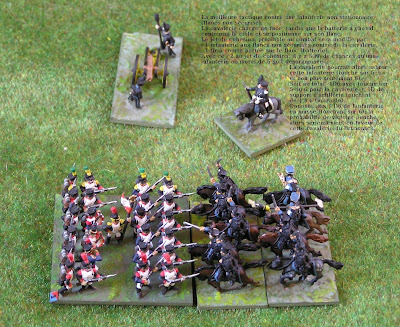
And finally, a small example of tactical attack, this cavalry division of Brunswick.
It will of course keep you from taking your attack against a battery side, the next round.
But the cavalry is expensive and it runs out quickly! Do not expect to play 10 times this maneuver at the heart of the battle. Even if you disrupt your enemy, you are not free from losses.

 Perry Brothers have had the good sense to bestow upon us a beautiful home that can perfectly fit into a Western decor. You can order on their site.


 The second house


